NYC DOT Sidewalk Requirements: Avoiding Fines with Professional Concrete Work
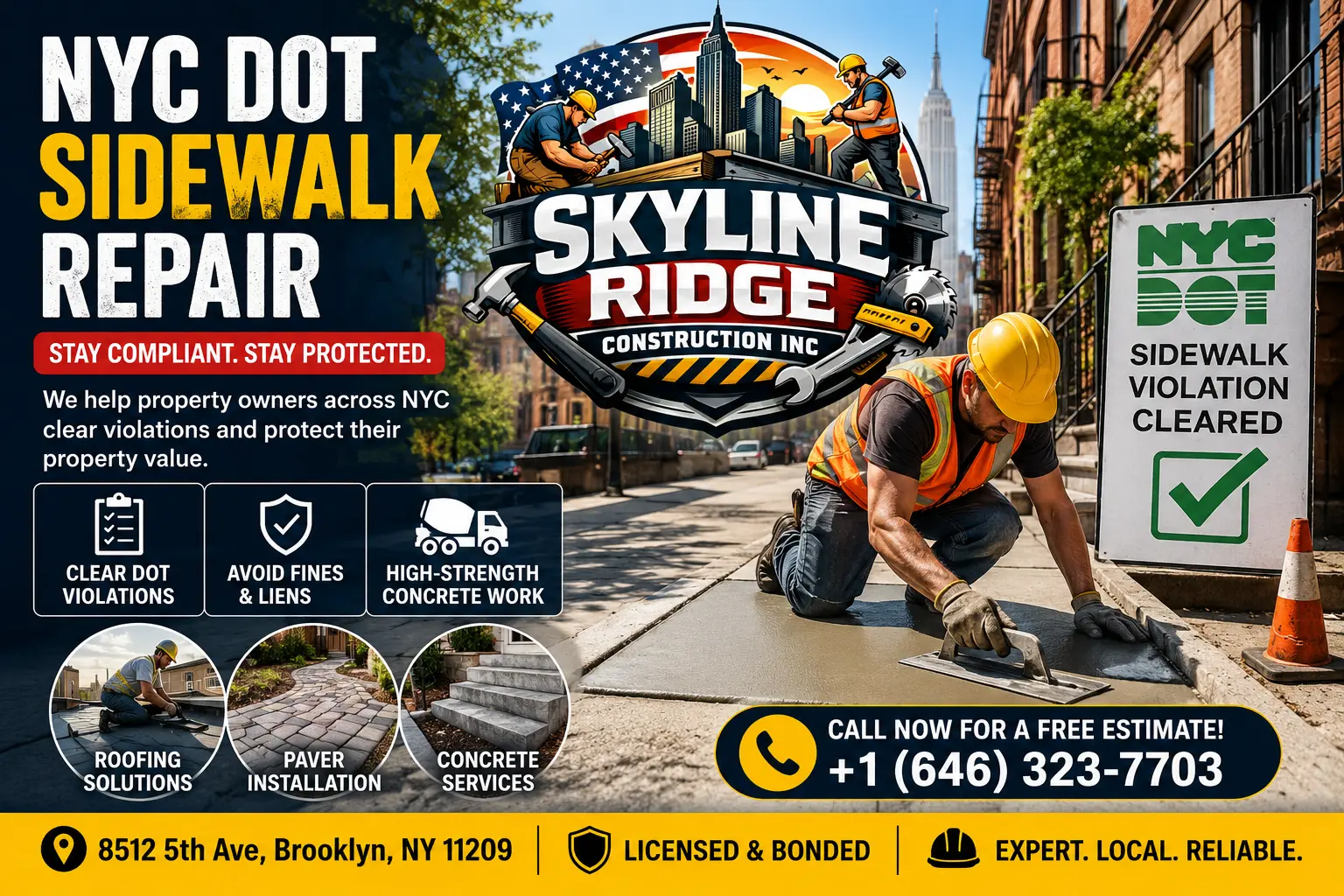
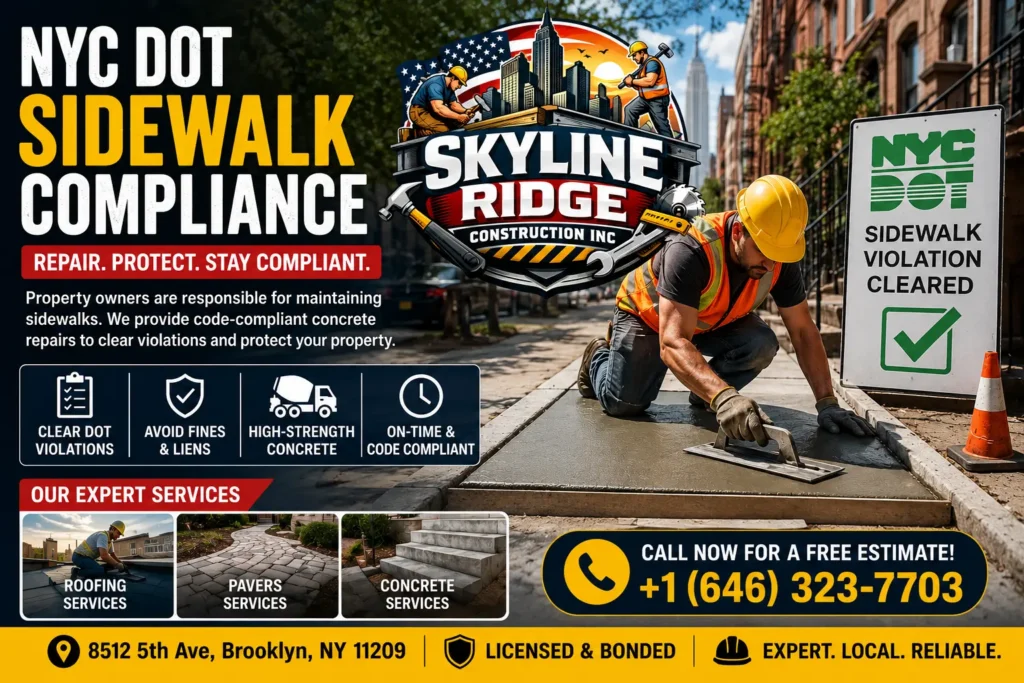
For property owners across New York City, maintaining the sidewalk directly in front of their home or commercial building is a strict legal obligation. Under NYC Administrative Code Section 19-152, the Department of Transportation (DOT) holds property owners fully responsible for the installation, maintenance, and repair of adjacent sidewalk flags. Failing to meet the official NYC DOT sidewalk requirements can result in costly city violations, heavy fines, and severe liability lawsuits if a pedestrian trips and suffers an injury.
When the DOT inspects a neighborhood and finds a defective sidewalk, they issue an official Notice of Violation to the owner. This notice acts as a legal lien on the property, making it incredibly difficult to sell, refinance, or clear your deed until the concrete is professionally repaired according to city regulations.
This comprehensive guide breaks down the official guidelines, common defects that trigger fines, and how professional concrete installation protects your property from legal headaches.
Table of Contents
Common Sidewalk Defects That Trigger NYC DOT Violations
The NYC DOT utilizes strict criteria to determine whether a sidewalk flag is dangerous or non-compliant. The most common structural defects include:
1. Vertical Trip Hazards (Uneven Flags)
If two adjacent concrete sidewalk flags have a vertical displacement or a height difference of 1/4 inch or greater, the city classifies it as a major trip hazard. This is often caused by shifting ground soil, heavy commercial vehicle loads, or underground tree roots pushing the concrete upward.
2. Deep Cracks and Structural Fractures
Sidewalk sections that contain one or more cracks that are 1/2 inch or wider or have loose, missing pieces of concrete will fail inspection. These fractures allow water to seep beneath the surface, accelerating ground erosion and worsening the damage during winter freeze-thaw cycles.
3. Improper Slope and Pooling Water
Sidewalks must have a specific cross-slope to ensure rainwater drains naturally toward the gutter. If a concrete flag sags, slopes toward the building foundation, or allows water to puddle continuously, it violates DOT drainage standards and creates dangerous sheets of black ice during local winter months.
Official NYC DOT Concrete Specifications
You cannot simply pour standard retail-grade concrete mix to fix a city sidewalk. The DOT enforces precise engineering material codes that must be followed to successfully clear a violation:
- Concrete Strength: All sidewalk flags must be poured using high-strength structural concrete rated at a minimum of 4,500 PSI (pounds per square inch).
- Flag Thickness: Standard residential pedestrian sidewalks must be at least 4 inches thick. However, if the sidewalk crosses over a residential or commercial driveway entrance, the thickness must be increased to at least 7 inches with steel mesh reinforcement to handle vehicle weight pressure.
- Sub-Base Compaction: A clean, stable sub-base consisting of at least 6 inches of clean granular fill or recycled concrete aggregate (RCA) must be laid and heavily compacted before the concrete pour to prevent future settling or sinking.
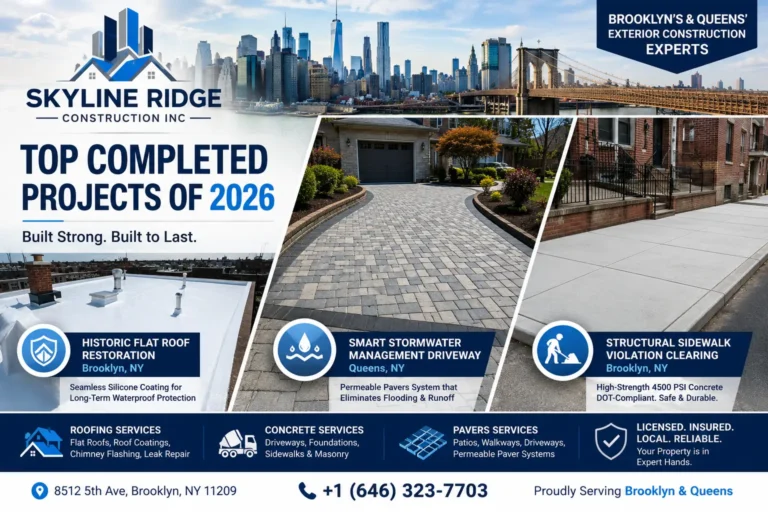
Quality Construction from the Roof to the Street: Navigating complex local structural rules requires experienced hands who understand NYC’s unique urban logistics. Whether we are clearing an urgent street-level concrete violation or engineering an advanced commercial roofing layout, local expertise ensures your building remains fully compliant. To see examples of how our local crews handle structural city restorations legally and safely, explore our full review of Skyline Ridge Construction: Our Top Completed Projects of 2026 to see our certified results.
The Legal Process of Clearing a Sidewalk Violation
If you have already received an official DOT sidewalk violation, the clock is ticking. Homeowners generally have 45 days from the notice date to hire a licensed contractor to perform the repairs.
- Secure the DOT Filing Permit: Your selected contractor must hold an active license and a valid bond with the city to pull an official DOT Sidewalk Repair Permit.
- Execute the Certified Concrete Repair: The defective flags are saw-cut, excavated, a structural sub-base is compacted, and the 4,500 PSI concrete is poured with proper expansion joints.
- Submit the Dismissal Request: Once completed, professional photos, permit documentation, and an official Request for Re-inspection are sent to the DOT to formally remove the violation lien from your property record.
Standard NYC DOT Sidewalk Requirements Repair
| Requirement Feature | Pedestrian Sidewalk Flag | Driveway Apron / Crossings |
| Minimum Concrete Strength | 4,500 PSI High-Strength Mix | 4,500 PSI with Steel Reinforcement |
| Minimum Depth / Thickness | 4 Inches | 7 Inches |
| Permit Requirement | Mandatory DOT Sidewalk Permit | Mandatory DOT & Curb Cut Permit |
| Expansion Joint Layout | Every 5 linear feet standard | Heavy-duty expansion strips at borders |
Complete Property Exterior Care Across NYC
At Skyline Ridge Construction Inc, we specialize in protecting your entire building envelope from city violations down to heavy weather wear. We are fully licensed, bonded, and certified with the city to manage your structural home improvements, commercial roofing, DOT concrete compliance, and premium paving layouts.
Explore our primary professional services to see how we can assist you today:
- Concrete Services: We specialize in high-strength concrete driveways, structural foundations, clearing NYC DOT sidewalk violations legally, and installing compliant masonry steps.
- Roofing Services: From emergency leak repairs and flat roof cool coatings to complete replacements and custom chimney flashing, we keep your home dry.
- Pavers Services: Our team designs and installs premium stone paver patios, customized walkways, interlocking driveways, and cutting-edge permeable paver systems built to survive harsh winters.
Give Skyline Ridge Construction Inc a call today at +1 (646) 323-7703 to schedule a free estimate to clear your sidewalk violation or start your next concrete project!
Areas We Serve
We proudly provide expert local concrete, roofing, and structural hardscaping solutions across the following unique New York City neighborhoods:
- Mapleton East (Brooklyn)
- Flushing Heights (Queens)
- Gravesend North (Brooklyn)
- Murray Hill South (Queens)
- Kensington North (Brooklyn)
- Pomonok East (Queens)
- Midwood Manor (Brooklyn)
- Utopia Heights (Queens)
- Homecrest West (Brooklyn)
- Electchester North (Queens)
FAQ’s
What happens if I ignore an NYC DOT sidewalk violation?
If you ignore the notice past the 45-day grace period, the city reserves the right to hire its own independent contractor to perform the repairs. However, city-contracted work is billed directly to the property owner at significantly higher, non-negotiable premium rates, and a formal tax lien will be attached to your property until the bill is paid in full.
Can a tree root issue be cleared without killing the neighborhood tree?
Yes. NYC Parks Department regulations strictly protect city trees. If a tree root has lifted a concrete flag, a certified concrete contractor must coordinate safely to shave or bridge over the root structure using specialized design techniques without cutting down or damaging the tree’s structural integrity.
How long does a newly poured DOT concrete sidewalk take to dry?
Standard high-strength 4,500 PSI concrete dries enough to handle foot traffic within 24 hours. However, vehicle traffic over driveways must be avoided for at least 3 to 5 days to allow the concrete pad to reach its necessary structural weight capacity.
Can bad sidewalk drainage cause leaking in my building’s upper systems or roofing?
While sidewalk water pooling directly threatens foundations and basements, a property suffering from general drainage neglected on the ground often indicates roof-level water failures too. If your roof drains are clogged or flat membranes are failing, rainwater will overflow down your exterior walls, worsening ground saturation. To see how to shield your roof from severe seasonal downpours, explore our comprehensive guide on Summer Roofing Maintenance: Preparing Your Roof for NYC Heatwaves to lock out moisture.
Get a Free Estimate Today
Looking for a top affordable roofing and concrete contractor in Brooklyn, New York?
Address: 8512 5th Ave, Brooklyn, NY 11209